Page 1
reviewedFROM ALEXANDRIA TO JAFFA
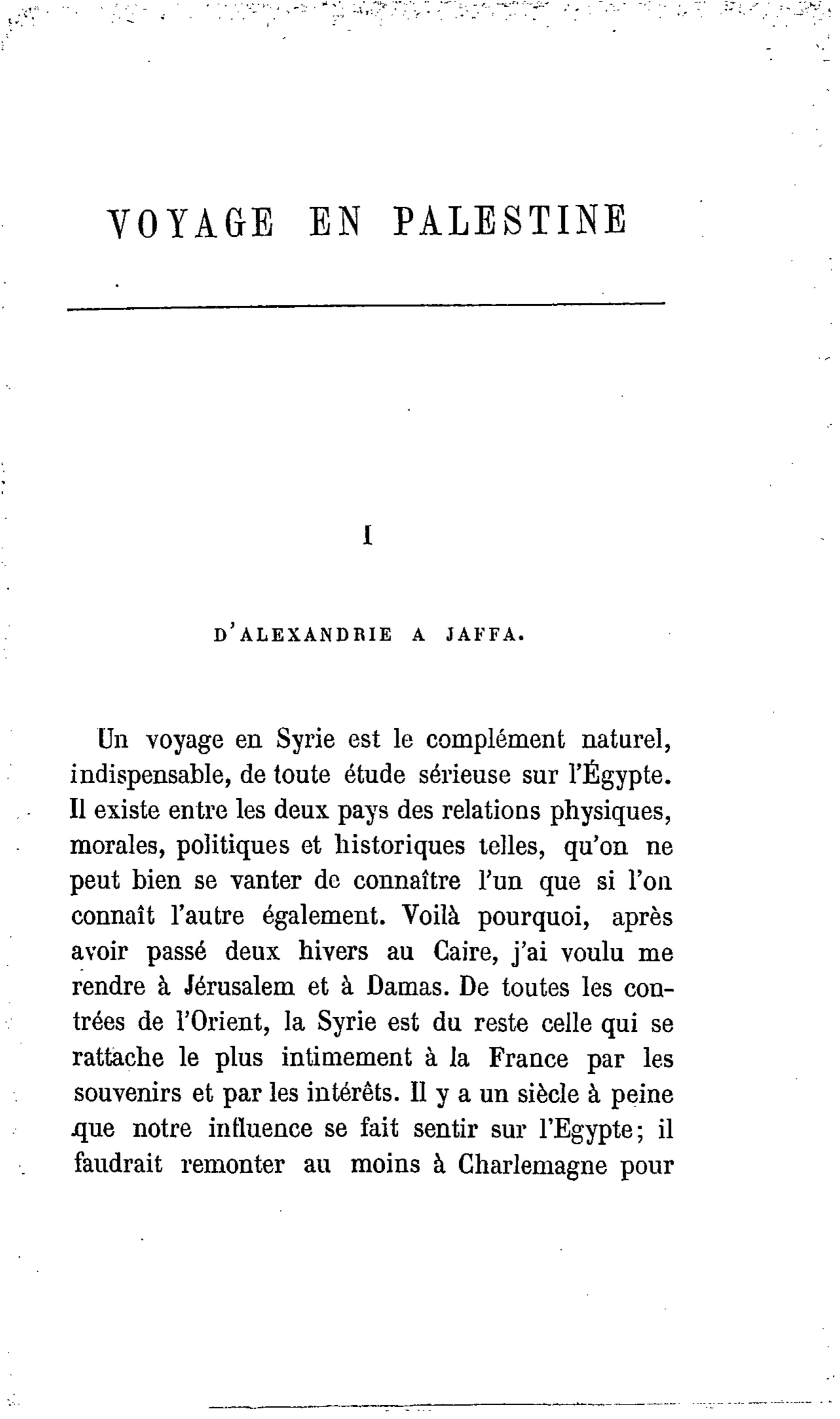
A trip in Syria is the natural, indispensable complement of all serious study of Egypt. Between the two countries exist physical, moral, political and historical relations of such a nature that you cannot claim to know one without knowing the other equally well. This is why, after having spent two winters in Cairo, I wanted to visit Jerusalem and Damascus. Of all the countries of the Orient, Syria is the one which is most intimate with France through its memories and its interests. Barely a century ago our influence was felt in Egypt; we would have to go back at least to Charlemagne to
Original French
D'ALEXANDRIE À JAFFA
Un voyage en Syrie est le complément naturel, indispensable, de toute étude sérieuse sur l'Égypte. Il existe entre les deux pays des relations physiques, morales, politiques et historiques telles, qu'on ne peut bien se vanter de connaître l'un que si l'on connaît l'autre également. Voilà pourquoi, après avoir passé deux hivers au Caire, j'ai voulu me rendre à Jérusalem et à Damas. De toutes les contrées de l'Orient, la Syrie est du reste celle qui se rattache le plus intimement à la France par les souvenirs et par les intérêts. Il y a un siècle à peine que notre influence se fait sentir sur l'Égypte ; il faudrait remonter au moins à Charlemagne pour
Notes. Chapter I, "D'Alexandrie à Jaffa" (From Alexandria to Jaffa) — opening page. Charmes frames Syria as the indispensable complement to Egypt and traces France's tie to the Levant back centuries.
On "Syria": when Charmes writes "la Syrie" in 1884 he means not the modern nation-state but Ottoman Greater Syria (Bilad al-Sham, the historical "Levant") — the whole region stretching from the Taurus Mountains down to the Sinai, taking in today's Syria, Lebanon, Jordan, Israel, and the Palestinian territories. It was not a country but a cluster of Ottoman administrative units (the vilayets of Damascus/Syria and Beirut, plus the autonomous districts of Mount Lebanon and of Jerusalem). That is why a single journey "in Syria" can run from Jerusalem in the south to Damascus in the north, and why Palestine — Charmes's real destination — is treated as simply the southern part of Syria. The modern borders of Syria, Lebanon, Israel/Palestine, and Jordan did not exist yet; they were drawn after the First World War, when the Ottoman Empire was partitioned between French and British mandates (1920).
France's centuries-old "tie to the Levant" that Charmes invokes runs from the chivalric memory of the Crusades through the Capitulations — the treaties, dating to François I and Süleyman the Magnificent in the 16th century, under which France claimed a protective role over Latin (Catholic) Christians and holy sites in the Ottoman lands. That self-assigned guardianship is the "interest" he has in mind, and it helps explain the proprietary tone of the French traveler toward the region.
Image and text from the Gallica / BnF scan (this leaf is missing from the physical copy).
Your key is stored only in this browser (localStorage) and sent directly to the provider. Use a key you're comfortable using client-side.