Page 2
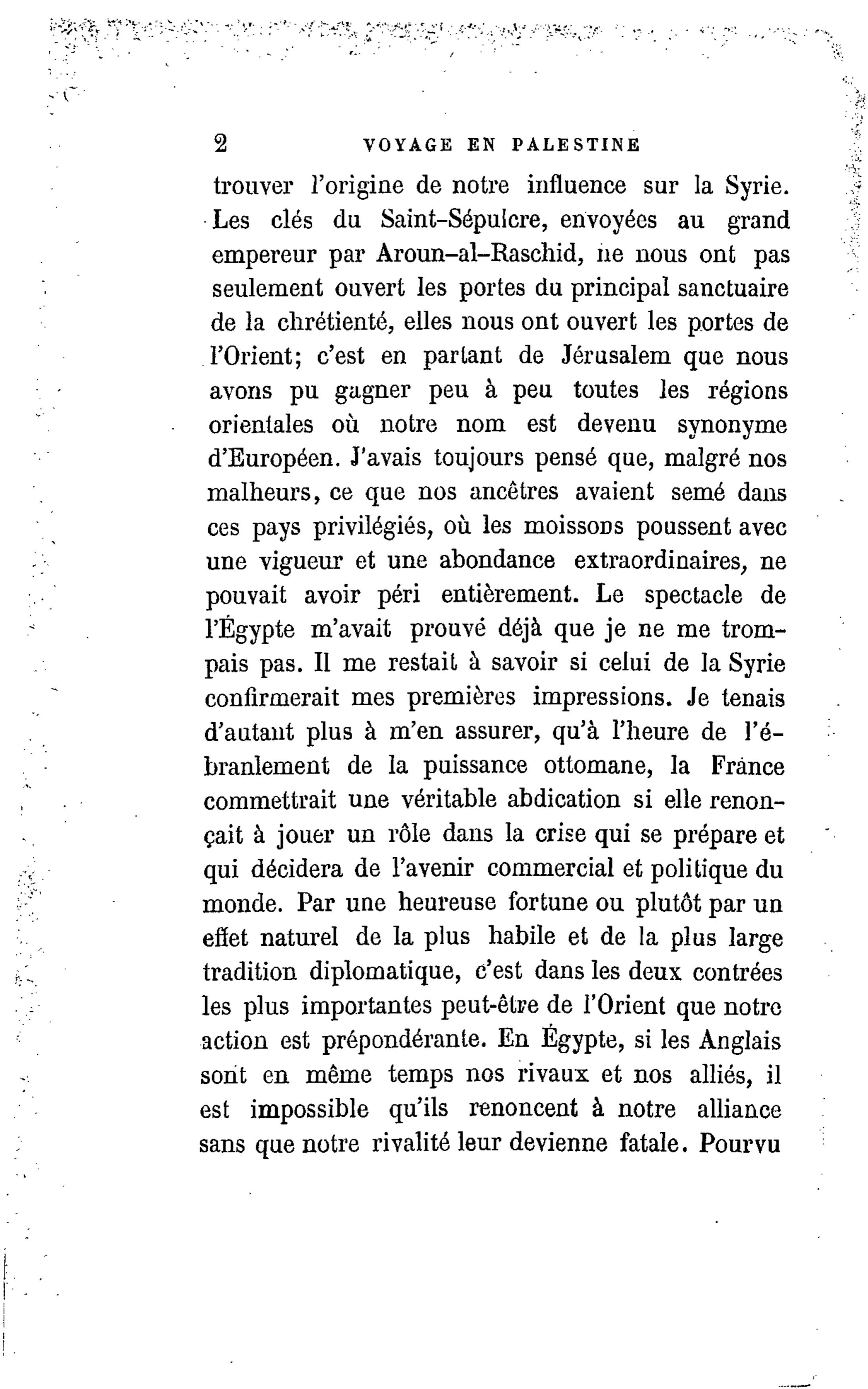
reviewedfind the origin of our influence on Syria. The keys of the Holy Sepulchre, sent to the great emperor by Harun al-Rashid, did not only open for us the doors of the principal sanctuary of Christendom, they opened for us the doors of the Orient; it was starting from Jerusalem that we were able to win, little by little, all those eastern regions where our name has become synonymous with European. I had always thought that, despite our misfortunes, what our ancestors had sown in these favored lands, where the harvests spring up with extraordinary vigor and abundance, could not have entirely perished. The spectacle of Egypt had already proven to me that I was not mistaken. It remained for me to learn whether that of Syria would confirm my first impressions. I was all the more anxious to make sure of it because, at the hour when Ottoman power totters, France would commit a true abdication were she to give up playing a part in the crisis now brewing, which will decide the commercial and political future of the world. By a happy fortune, or rather as the natural result of the most skilful and farthest-reaching diplomatic tradition, it is in the two perhaps most important lands of the Orient that our action is preponderant. In Egypt, though the English are at once our rivals and our allies, it is impossible for them to give up our alliance without our rivalry becoming fatal to them. Provided
Original French
trouver l'origine de notre influence sur la Syrie. Les clés du Saint-Sépulcre, envoyées au grand empereur par Aroun-al-Raschid, ne nous ont pas seulement ouvert les portes du principal sanctuaire de la chrétienté, elles nous ont ouvert les portes de l'Orient ; c'est en partant de Jérusalem que nous avons pu gagner peu à peu toutes les régions orientales où notre nom est devenu synonyme d'Européen. J'avais toujours pensé que, malgré nos malheurs, ce que nos ancêtres avaient semé dans ces pays privilégiés, où les moissons poussent avec une vigueur et une abondance extraordinaires, ne pouvait avoir péri entièrement. Le spectacle de l'Égypte m'avait prouvé déjà que je ne me trompais pas. Il me restait à savoir si celui de la Syrie confirmerait mes premières impressions. Je tenais d'autant plus à m'en assurer, qu'à l'heure de l'ébranlement de la puissance ottomane, la France commettrait une véritable abdication si elle renonçait à jouer un rôle dans la crise qui se prépare et qui décidera de l'avenir commercial et politique du monde. Par une heureuse fortune ou plutôt par un effet naturel de la plus habile et de la plus large tradition diplomatique, c'est dans les deux contrées les plus importantes peut-être de l'Orient que notre action est prépondérante. En Égypte, si les Anglais sont en même temps nos rivaux et nos alliés, il est impossible qu'ils renoncent à notre alliance sans que notre rivalité leur devienne fatale. Pourvu
Notes. Chapter I, page 2. (Image and text from the Gallica / BnF scan — this leaf is missing from the physical copy. Awaiting English translation.)
The keys of the Holy Sepulchre: Charmes roots France's claim in the East in the legendary friendship between Charlemagne and the Abbasid caliph Harun al-Rashid (here "Aroun-al-Raschid," r. 786–809, the caliph of the Thousand and One Nights). Around 800 the two rulers exchanged embassies and famous gifts — Harun's included a water clock and an elephant named Abul-Abbas — and Frankish chroniclers recorded that the caliph sent Charlemagne the keys (and banner) of the Holy Sepulchre in Jerusalem, seeming to acknowledge him as protector of the Christians and holy places there. Modern historians treat the "protectorate" as much exaggerated — at most Charlemagne won the right to endow churches and a hostel for pilgrims — but the story became the founding myth of France's self-appointed role as guardian of the Latin Christians of the Levant, the tradition later formalized in the Capitulations (see the note on Chapter I, page 1). Charmes invokes it to argue that this guardianship, not mere recent ambition, is the deep root of French influence in Syria.
The closing lines look to his own moment: "à l'heure de l'ébranlement de la puissance ottomane" (as Ottoman power totters) reflects the widely shared 19th-century expectation that the Ottoman Empire — the "sick man of Europe" — was breaking up, and that the European powers were maneuvering to inherit its provinces. Charmes frames French presence in Egypt and Syria as the stake France must not forfeit in that coming partition.
Your key is stored only in this browser (localStorage) and sent directly to the provider. Use a key you're comfortable using client-side.