Page 4
translatedly to maintain, but to increase, the work of the past.
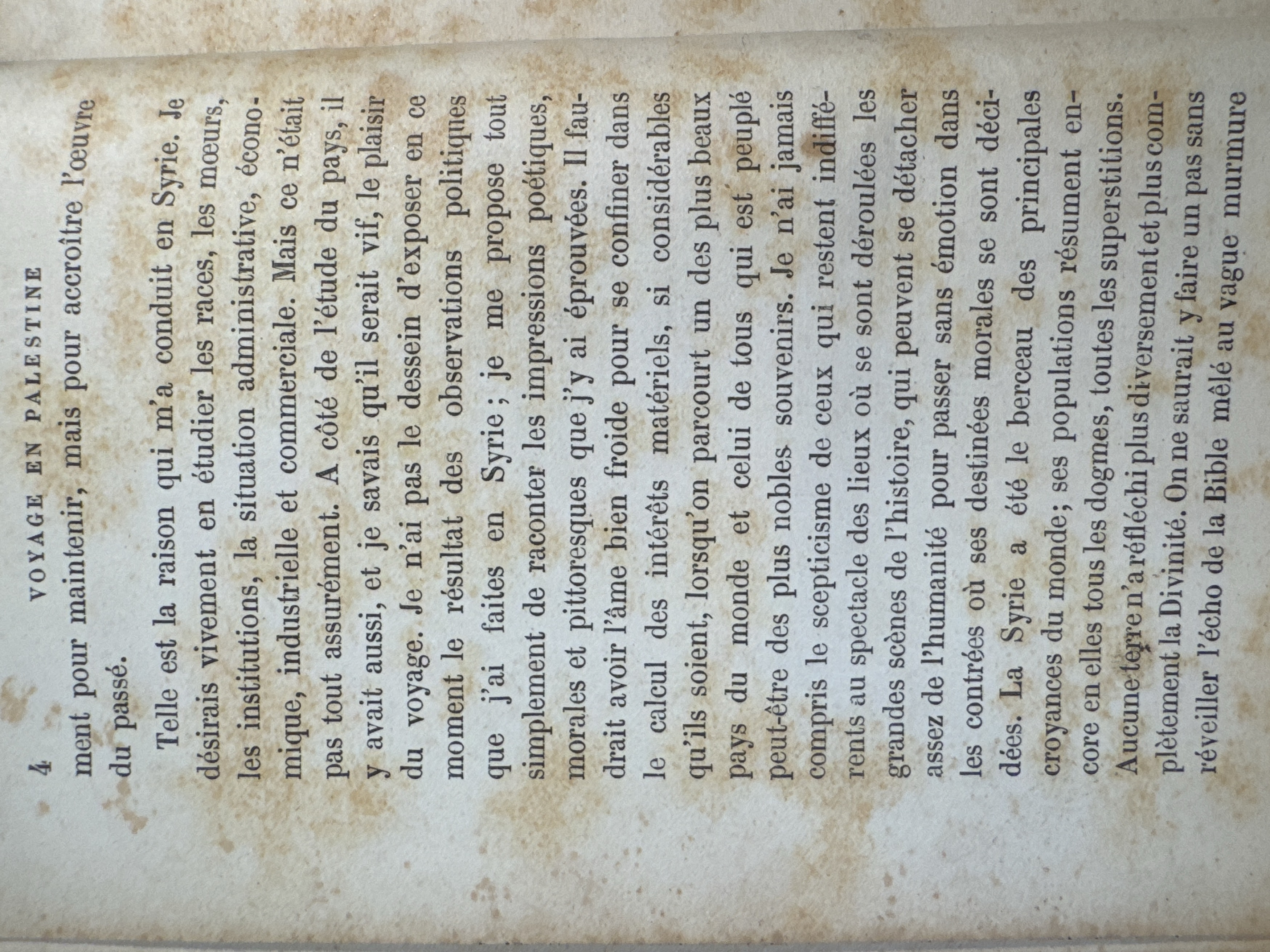
Such is the reason that led me to Syria. I keenly desired to study its races, its manners, its institutions, its administrative, economic, industrial, and commercial situation. But that, assuredly, was not all. Beside the study of the country there was also — and I knew it would be keen — the pleasure of the journey. I do not intend to set out at this moment the result of the political observations I made in Syria; I propose quite simply to recount the poetic, moral, and picturesque impressions I felt there. One would need a very cold soul to confine oneself to the calculation of material interests, however considerable they may be, when traveling through one of the most beautiful countries in the world — and the one of all, perhaps, peopled with the noblest memories. I have never understood the skepticism of those who remain indifferent before the spectacle of the places where the great scenes of history unfolded, who can detach themselves from humanity enough to pass without emotion through the lands where its moral destinies were decided. Syria was the cradle of the world's principal beliefs; its peoples still sum up in themselves every dogma and every superstition. No land has reflected the Divinity more diversely or more completely. One cannot take a step there without awakening the echo of the Bible, mingled with the vague murmur
Original French
ment pour maintenir, mais pour accroître l'œuvre du passé.
Telle est la raison qui m'a conduit en Syrie. Je désirais vivement en étudier les races, les mœurs, les institutions, la situation administrative, économique, industrielle et commerciale. Mais ce n'était pas tout assurément. A côté de l'étude du pays, il y avait aussi, et je savais qu'il serait vif, le plaisir du voyage. Je n'ai pas le dessein d'exposer en ce moment le résultat des observations politiques que j'ai faites en Syrie ; je me propose tout simplement de raconter les impressions poétiques, morales et pittoresques que j'y ai éprouvées. Il faudrait avoir l'âme bien froide pour se confiner dans le calcul des intérêts matériels, si considérables qu'ils soient, lorsqu'on parcourt un des plus beaux pays du monde et celui de tous qui est peuplé peut-être des plus nobles souvenirs. Je n'ai jamais compris le scepticisme de ceux qui restent indifférents au spectacle des lieux où se sont déroulées les grandes scènes de l'histoire, qui peuvent se détacher assez de l'humanité pour passer sans émotion dans les contrées où ses destinées morales se sont décidées. La Syrie a été le berceau des principales croyances du monde ; ses populations résument encore en elles tous les dogmes, toutes les superstitions. Aucune terre n'a réfléchi plus diversement et plus complètement la Divinité. On ne saurait y faire un pas sans réveiller l'écho de la Bible mêlé au vague murmure
Notes. Chapter I, page 4 — the chapter's hinge. After three pages of geopolitics, Charmes announces what this book actually is: the political results of the journey are deliberately withheld (he was publishing political analysis of the Eastern question all the while in the press — see the title-page note on his career), and what remains is exactly the program of the Avant-propos: "poetic, moral, and picturesque impressions," nothing more (see the notes on foreword pages II and IV — the "simple traveler," the "scents or dusts of the road").
"Syria was the cradle of the world's principal beliefs": within Charmes's "Syria" — Ottoman Greater Syria, which includes Palestine (see the note on Chapter I, page 1) — Judaism and Christianity were born, and Islam, born in Arabia, made Damascus the seat of its first great dynasty, the Umayyad caliphate (661–750). The remark that its peoples "still sum up in themselves every dogma and every superstition" reflects the human mosaic the 19th-century traveler met there: Sunni and Shia Muslims, Alawites, Druze, Maronite and Orthodox and Melkite Christians, Armenians, Jews — each community with its own rites, law, and quarter.
The closing sentiment — that no one should pass unmoved through lands where "the moral destinies" of humanity were decided — restates in a secular key the lakeside emotion of the foreword (see pages III and V): a pilgrimage for a man who no longer quite believes, drawn by history and landscape to the places where faith began.
The page ends mid-sentence ("…the echo of the Bible, mingled with the vague murmur"); the sentence continues on page 5 of the book, not yet photographed.
Your key is stored only in this browser (localStorage) and sent directly to the provider. Use a key you're comfortable using client-side.