Page 3
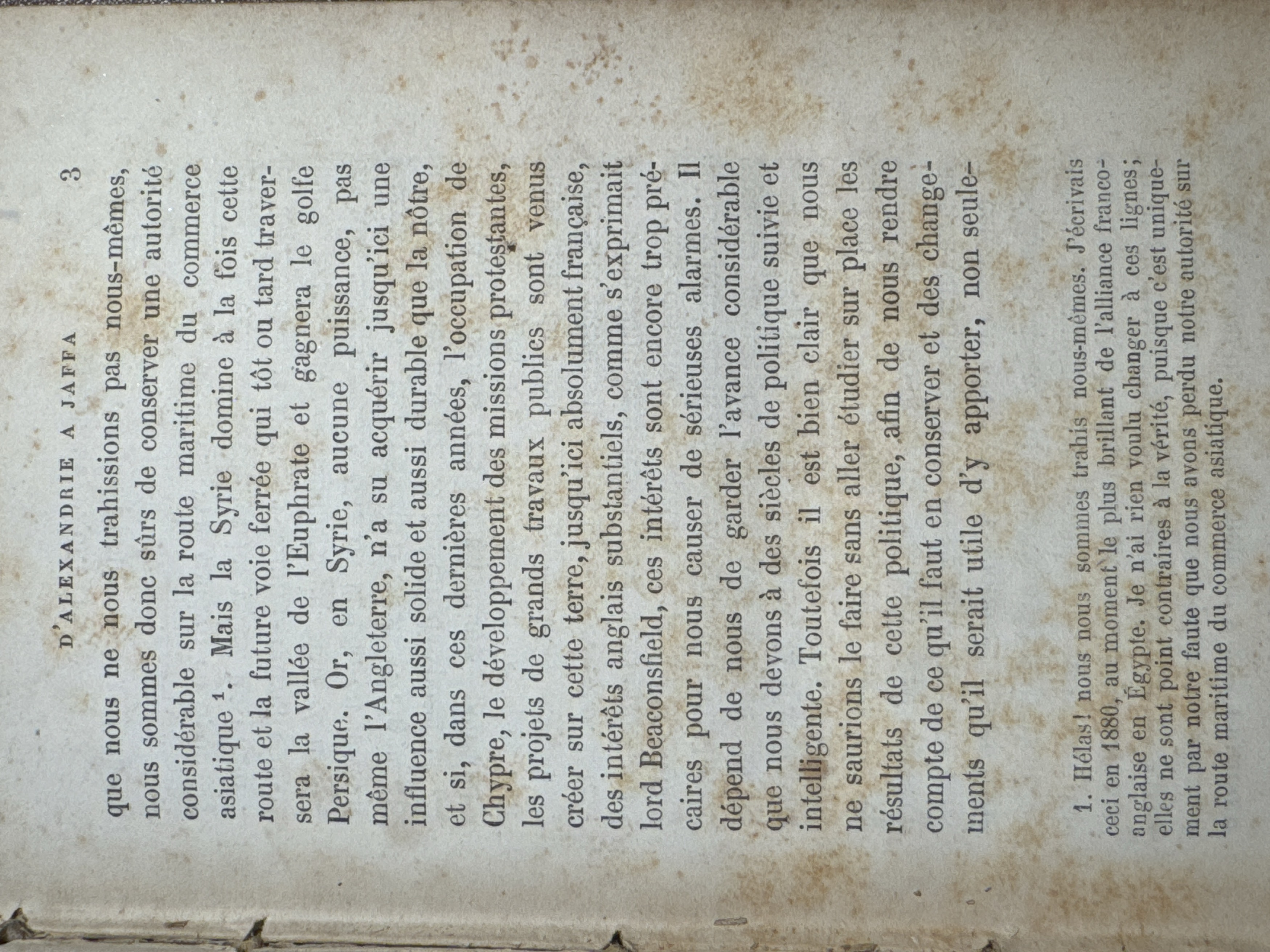
reviewedthat we do not betray ourselves, we are therefore sure of keeping a considerable authority over the maritime route of the Asian trade¹. But Syria commands both this route and the future railway which, sooner or later, will cross the valley of the Euphrates and reach the Persian Gulf. Now, in Syria, no power, not even England, has hitherto managed to acquire an influence as solid and as lasting as ours, and if, in recent years, the occupation of Cyprus, the development of the Protestant missions, and the schemes for great public works have come to create on this soil, hitherto absolutely French, substantial English interests, as Lord Beaconsfield put it, those interests are still too precarious to cause us serious alarm. It rests with us to keep the considerable lead we owe to centuries of sustained and intelligent policy. It is quite clear, however, that we could not do so without going to study on the spot the results of that policy, in order to realize what should be kept of it and what changes it would be useful to make to it, not only-
———
1. Alas! we have betrayed ourselves. I wrote this in 1880, at the most brilliant moment of the Franco-English alliance in Egypt. I have not wished to change anything in these lines; they are in no way contrary to the truth, since it is solely through our own fault that we have lost our authority over the maritime route of the Asian trade.
Original French
que nous ne nous trahissions pas nous-mêmes, nous sommes donc sûrs de conserver une autorité considérable sur la route maritime du commerce asiatique¹. Mais la Syrie domine à la fois cette route et la future voie ferrée qui tôt ou tard traversera la vallée de l'Euphrate et gagnera le golfe Persique. Or, en Syrie, aucune puissance, pas même l'Angleterre, n'a su acquérir jusqu'ici une influence aussi solide et aussi durable que la nôtre, et si, dans ces dernières années, l'occupation de Chypre, le développement des missions protestantes, les projets de grands travaux publics sont venus créer sur cette terre, jusqu'ici absolument française, des intérêts anglais substantiels, comme s'exprimait lord Beaconsfield, ces intérêts sont encore trop précaires pour nous causer de sérieuses alarmes. Il dépend de nous de garder l'avance considérable que nous devons à des siècles de politique suivie et intelligente. Toutefois il est bien clair que nous ne saurions le faire sans aller étudier sur place les résultats de cette politique, afin de nous rendre compte de ce qu'il faut en conserver et des changements qu'il serait utile d'y apporter, non seule-
———
1. Hélas ! nous nous sommes trahis nous-mêmes. J'écrivais ceci en 1880, au moment le plus brillant de l'alliance franco-anglaise en Égypte. Je n'ai rien voulu changer à ces lignes ; elles ne sont point contraires à la vérité, puisque c'est uniquement par notre faute que nous avons perdu notre autorité sur la route maritime du commerce asiatique.
Notes. Chapter I, page 3 (photographed; text verified against the Gallica scan). Awaiting English translation.
This page is dense with the Anglo-French "Great Game" over the road to India, so several references are worth unpacking:
• The future railway "through the Euphrates valley to the Persian Gulf" is the Euphrates Valley Railway, a much-promoted (and never-built in this form) 19th-century British scheme for a rail shortcut from the Mediterranean to the Gulf and on to India — a rival to, and later overtaken by, the German-backed Berlin–Baghdad Railway. Charmes's point is that Syria commands both this overland route and the sea route through Suez.
• "L'occupation de Chypre" — Britain took over the administration of Cyprus from the Ottomans in 1878 under the Cyprus Convention, secured at the Congress of Berlin as a base from which to defend its eastern interests.
• "Les missions protestantes" — the growing British and American Protestant missionary presence in Syria and Lebanon (schools, presses, and colleges such as the Syrian Protestant College, founded 1866, the future American University of Beirut), which Charmes reads as a vector of Anglo-American, not French, influence in a region he considers culturally French.
• "Lord Beaconsfield" is Benjamin Disraeli (1804–1881), the British Conservative prime minister (made Earl of Beaconsfield in 1876) who architected the Cyprus deal and Britain's forward policy in the East; Charmes borrows the phrase "substantial English interests" from him.
• The footnote ¹ ("Hélas ! nous nous sommes trahis nous-mêmes…") is a later addition in which Charmes laments that France did betray itself: he wrote the optimistic main text in 1880, "at the most brilliant moment of the Franco-English alliance in Egypt," but by the time of publication France had — by its own choice — let Britain occupy Egypt alone (the British occupation of 1882, after the French parliament declined to join the intervention), forfeiting the very position the passage celebrates.
Your key is stored only in this browser (localStorage) and sent directly to the provider. Use a key you're comfortable using client-side.