Page VI
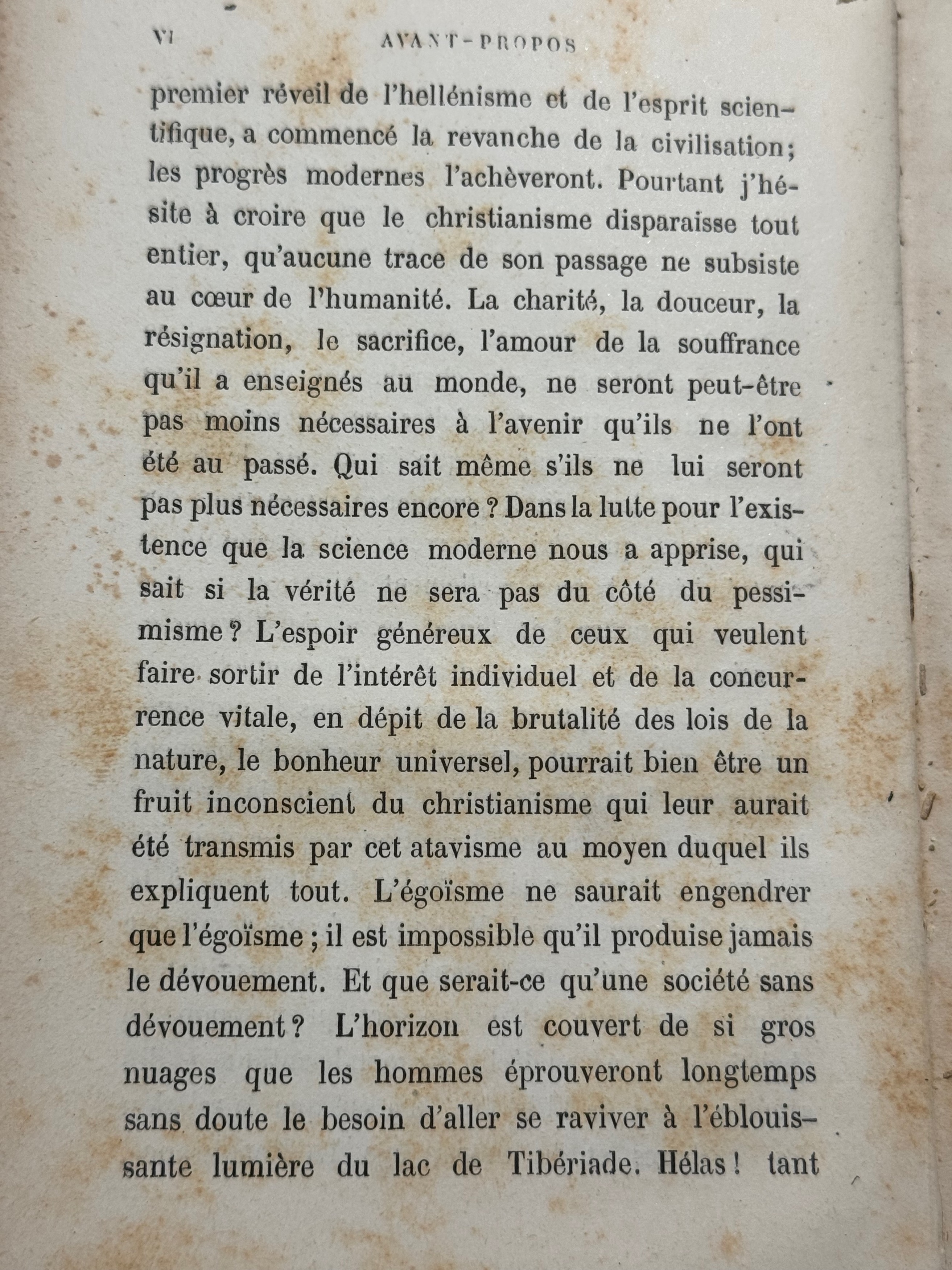
translatedfirst awakening of Hellenism and the scientific spirit started the revenge of civilization; modern progress will finish it. Yet I hesitate to believe that Christianity disappears entirely, that a trace of its passage won't subsist in the heart of humanity. The charity, meekness, resignation, sacrifice, and love of suffering that it taught the world will perhaps be no less necessary in the future than they were in the past. Who knows if they will not be even more necessary? In the fight for existence that modern science taught us, who knows if the truth is not on the side of pessimism? The generous hope of those who want to bring forth — out of individual interest and vital competition, in spite of the brutality of the laws of nature — universal happiness, could well be the unconscious fruit of Christianity which had been transmitted to them by that atavism through which they explain everything. Selfishness can only engender selfishness; it is impossible that it would produce devotion. And what would a society be without devotion? The horizon is covered with such big clouds that men will no doubt long feel the need to go and revive themselves in the dazzling light of the Sea of Galilee. Alas! …
Original French
premier réveil de l'hellénisme et de l'esprit scientifique, a commencé la revanche de la civilisation ; les progrès modernes l'achèveront. Pourtant j'hésite à croire que le christianisme disparaisse tout entier, qu'aucune trace de son passage ne subsiste au cœur de l'humanité. La charité, la douceur, la résignation, le sacrifice, l'amour de la souffrance qu'il a enseignés au monde, ne seront peut-être pas moins nécessaires à l'avenir qu'ils ne l'ont été au passé. Qui sait même s'ils ne lui seront pas plus nécessaires encore ? Dans la lutte pour l'existence que la science moderne nous a apprise, qui sait si la vérité ne sera pas du côté du pessimisme ? L'espoir généreux de ceux qui veulent faire sortir de l'intérêt individuel et de la concurrence vitale, en dépit de la brutalité des lois de la nature, le bonheur universel, pourrait bien être un fruit inconscient du christianisme qui leur aurait été transmis par cet atavisme au moyen duquel ils expliquent tout. L'égoïsme ne saurait engendrer que l'égoïsme ; il est impossible qu'il produise jamais le dévouement. Et que serait-ce qu'une société sans dévouement ? L'horizon est couvert de si gros nuages que les hommes éprouveront longtemps sans doute le besoin d'aller se raviver à l'éblouissante lumière du lac de Tibériade. Hélas ! tant
Notes. Avant-propos, page VI — the foreword's closing argument on this leaf, weighing whether Christianity's virtues survive modern "progress." "La revanche de la civilisation" = the revenge of civilization; "le lac de Tibériade" = the Sea of Galilee. The page breaks mid-sentence at "Hélas ! tant…"; the sentence continues on the next page (now added as page VII), and the English keeps the "…" to mark the cut.
The intellectual backdrop here is the science and philosophy that gripped Charmes's generation. "La lutte pour l'existence" (the struggle for existence) is the language of Darwin, whose On the Origin of Species (1859) had been absorbed into French thought by the 1870s–80s; "la concurrence vitale" (vital competition / the struggle of life) was the standard French rendering of the same idea, and "atavism" — heredity reaching back to remote ancestors — was another of the new evolutionary watchwords. Against this Darwinian picture of nature as brutal competition, Charmes sets the era's fashionable "pessimism," the philosophy of Arthur Schopenhauer (and his then-popular disciple Eduard von Hartmann), which held that existence is suffering and the will blind — a vogue much debated in France around 1880. Charmes's worry is pointed: if life is nothing but the struggle for survival, the selfless virtues Christianity taught (charity, devotion, "the love of suffering") have no natural source — "selfishness can only engender selfishness" — and a purely scientific civilization may find it has quietly cut away the root of its own moral life.
Your key is stored only in this browser (localStorage) and sent directly to the provider. Use a key you're comfortable using client-side.