Page III
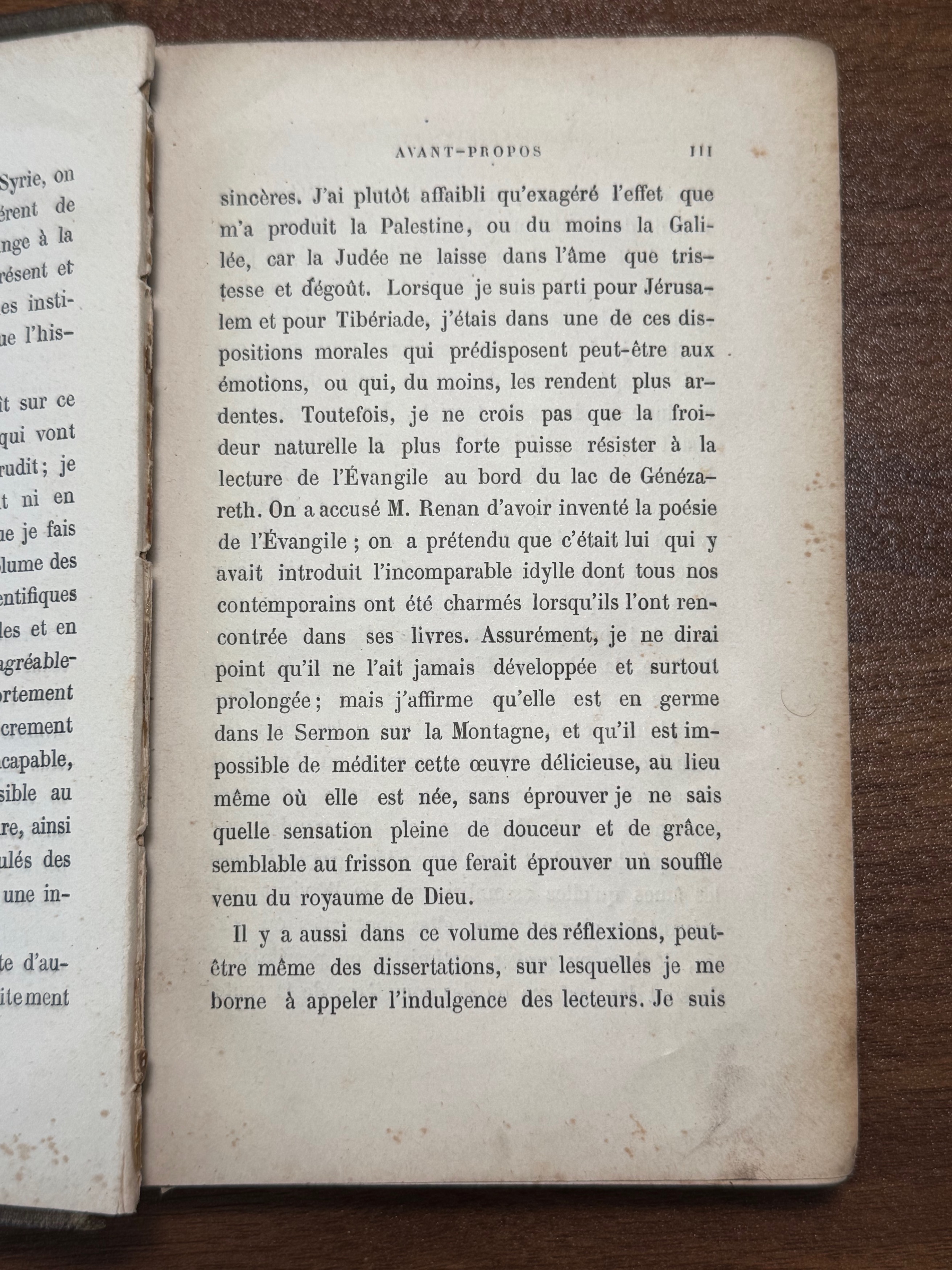
translatedsincere. I weakened rather than exaggerated the extent that I was affected by Palestine, or at least Galilee, because Judea only leaves sadness and disgust in my soul. When I left for Jerusalem and for Tiberias, I was in one of those moral dispositions which perhaps predispose to emotions, or which, at least, render them more fervent. However, I do not believe that the strongest natural coldness could resist reading the Gospel at the edge of the Sea of Galilee. M. Renan was accused of having invented the poetry of the Gospel; it was claimed that it was he who had introduced the incomparable idyll which charmed all our contemporaries when they encountered it in his books. Certainly, I will not say that he never developed or prolonged it; but I affirm that it was germinating in the Sermon on the Mount, and that it is impossible to meditate upon this delicious work, in the very place it was born, without experiencing I know not what soft and graceful sensation, similar to the thrill that would come from a breath from the kingdom of God.
There are also in this volume reflections, maybe even essays, for which I limit myself to calling on the readers' indulgence. I am
Original French
sincères. J'ai plutôt affaibli qu'exagéré l'effet que m'a produit la Palestine, ou du moins la Galilée, car la Judée ne laisse dans l'âme que tristesse et dégoût. Lorsque je suis parti pour Jérusalem et pour Tibériade, j'étais dans une de ces dispositions morales qui prédisposent peut-être aux émotions, ou qui, du moins, les rendent plus ardentes. Toutefois, je ne crois pas que la froideur naturelle la plus forte puisse résister à la lecture de l'Évangile au bord du lac de Génézareth. On a accusé M. Renan d'avoir inventé la poésie de l'Évangile, ou prétendu que c'était lui qui y avait introduit l'incomparable idylle dont tous nos contemporains ont été charmés lorsqu'ils l'ont rencontrée dans ses livres. Assurément, je ne dirai point qu'il ne l'ait jamais développée et surtout prolongée ; mais j'affirme qu'elle est en germe dans le Sermon sur la Montagne, et qu'il est impossible de méditer cette œuvre délicieuse, au lieu même où elle est née, sans éprouver je ne sais quelle sensation pleine de douceur et de grâce, semblable au frisson que ferait éprouver un souffle venu du royaume de Dieu.
Il y a aussi dans ce volume des réflexions, peut-être même des dissertations, sur lesquelles je me borne à appeler l'indulgence des lecteurs. Je suis
Notes. Avant-propos, page III. "Le lac de Génézareth" is the Sea of Galilee; "le Sermon sur la Montagne" is the Sermon on the Mount.
"M. Renan" is Ernest Renan (1823–1892), the era's most famous and most controversial writer on early Christianity. His best-selling Vie de Jésus (1863) recast Jesus as a human figure of incomparable moral charm and set his story in a lovingly drawn Galilean landscape — a "fifth Gospel," Renan called the land itself. The book scandalized the Church (it denied Jesus's divinity) and made Renan a lightning rod; the "accusation" Charmes reports — that Renan had "invented the poetry of the Gospel" — is the charge that this romantic beauty was Renan's literary embroidery rather than something really there. Charmes's reply is that the poetry is genuinely in the place: that even "the strongest natural coldness" could not read the Gospel by the Sea of Galilee unmoved.
Charmes's harsh contrast — radiant Galilee against a Judea that "leaves only sadness and disgust in the soul" — itself echoes Renan, who had drawn the same opposition between the gentle northern lake country where Jesus preached and the arid, austere south around Jerusalem.
Your key is stored only in this browser (localStorage) and sent directly to the provider. Use a key you're comfortable using client-side.